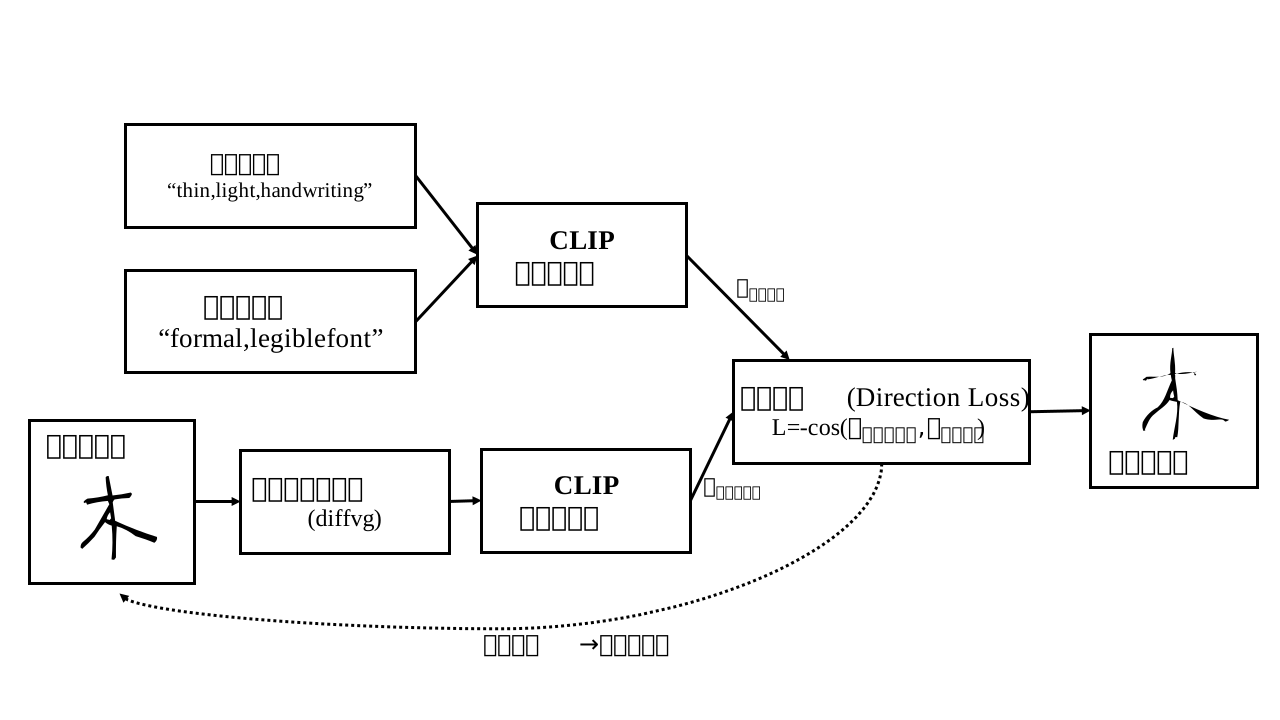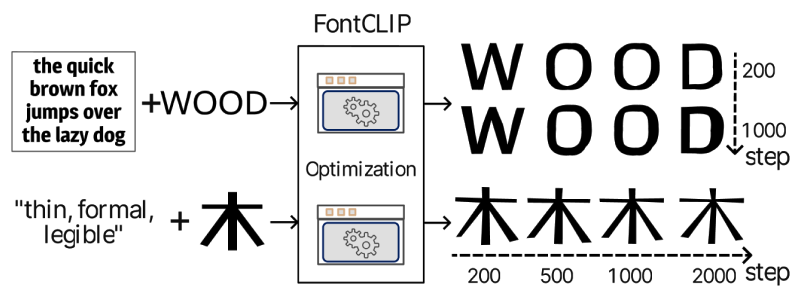
Prompt-driven font editing is an emerging application of vision-language mod- els in graphics. The recent FontCLIP couples cross-modal semantic alignment with differentiable rasterization to optimize a glyph’s Bézier control points at in- ference time, editing it into attribute-specific styles such as thin or bold from a prompt. Such methods, however, have been validated mainly on Latin computer typefaces; Chinese characters appear only as a single illustrative glyph, with neither systematic treatment nor quantitative evaluation, leaving Chinese handwriting edit- ing—structurally more complex and carrying personal style—unexplored. Using FontCLIP as its base framework, this study presents a systematic evaluation and optimization of VLM-based Chinese handwriting editing. Twenty representative characters were optimized on a handwriting font against a thin computer typeface under three prompts for 120 trials, with a systematic loss-weight search yielding a reproducible hyperparameter configuration. To address the original method’s lack of quantitative evaluation, we adopt the direction cosine, a metric aligned with Font- CLIP’s training direction loss, to measure how well a glyph’s movement in seman- tic space aligns with the target direction. Across all combinations, glyphs consis- tently moved toward the intended direction: thin and bold were stable, whereas the more abstract relaxed prompt was markedly weaker, reflecting a cross-cultural gap in FontCLIP’s Western-dominated training data. Closed contours, rather than stroke count alone, were the key factor limiting quality—open-contour characters deformed stably while closed-contour ones collapsed under thin optimization—and semantic alignment and visual legibility proved to be two independent dimensions. Overall, the adopted metric, the hyperparameter configuration established here, and the ability-boundary analysis fill this gap for Chinese handwriting editing.